Shore stories: discover Huriawa Peninsula
On the dramatic Huriawa Peninsula, Claudia Babirat is taken on a journey of history, culture and connection by mana whenua, who bring this coastal landscape to life.
“Down there was the secret freshwater spring that helped Te Wera and his people survive,” Irie Pomare points out.
We’re standing on the spine of Huriawa Peninsula, a rugged outcrop of spectacular yellow-orange cliffs looking back towards Karitāne, a small community located along the sweeping Otago coastline just 30 minutes’ drive north of Dunedin.
“In around 1740, a fortified settlement was built here by a Kāi Tahu chief called Te Wera, and his people,” Irie explains. Huriawa Pā was a favoured pā site because it offered a defensive advantage against attacks, it was sheltered from the wind, and it sustained people with kaimoana.
Her husband Tau takes up the story. “The significance of this place is the siege that happened here.” There was an ongoing feud between Kāi Tahu chiefs, which eventually led to an attack on Te Wera’s pā by chief Taoka from near Moeraki to the north. He planned to starve Te Wera out.
But Te Wera and his people stood firm. Their preparation, the strength of the pā fortifications and the presence of a concealed freshwater spring kept them safe for months.
Our gazes linger a few more moments on the little basin below us, surrounded by tī, harakeke and other regenerating native plants, before Irie and Tau continue leading the way along the loop track.
Although Huriawa Peninsula has been open to the public for many years, those wanting a deeper understanding of the area now have another option – to join a guided tour provided by Kāti Huirapa Rūnaka ki Puketeraki, the mana whenua who own and operate Karitāne Māori Tours.
“The people of Karitāne are proud of their place and community and how beautiful it is,” I’m later told by Amy Parata, who took on the role as Karitāne Māori Tour’s manager 18 months ago after spending several years living overseas.
“The tours started back in 2018 – it was definitely an evolution,” she laughs, “Initially we provided kayaks for hire, later teaming up with the waka club, then adding the walking tour.”
“We want to share our myths, legends and factual stories, as well as what we do on an environmental level”
These days two unique experiences are offered to visitors, each lasting two hours. “We want to share our myths, legends and factual stories, as well as what we do on an environmental level. It’s about getting people involved in something that is historically and culturally ‘us’.”
This includes embracing the area’s European history. Back on our peninsula tour, Tau points to the northern coastline of Huriawa Peninsula, near the mouth of the Waikouaiti River. In 1837 Sydney merchants Long, Wright and Richards established a whaling station here, selling it a year later to Johnny Jones, who is credited with bringing Europeans to the area just north of Karitāne.
The challenging task of catching and processing a whale required long days of demanding labour, attracting new people to the region and providing jobs for locals, making the area an important site of cross-cultural contact. Unfortunately, within a decade the tohorā population was decimated, leading to the demise of the whaling industry in the area.
Next to arrive were the Wesleyan missionaries. The first mission station of any denomination in the South Island was set up near Huriawa in 1840 by Reverend James Watkin.
Irie points out the marker that commemorates the first Christian sermon in Otago given here by Watkin on 17 May 1840. “He preached a story of peace,” says Irie. “Because of the peninsula’s past, peace is what our people wanted. They were ready to convert.”
But contact with Europeans came at a high price.
As we walk along the estuary, Irie and Tau point out the bushed-up banks behind the adventure playground that once served as mass graves for the many Māori who succumbed to highly contagious measles, against which they had no natural immunity.
Colonisation also led to Huriawa being surveyed off for residential development and Crown reserve land. The reserve lands were eventually returned to Te Rūnanga o Ngāi Tahu under section 142 of the Ngāi Tahu Claims Settlement Act 1998 and are now jointly managed by the Kāti Huirapa Rūnaka ki Puketeraki on behalf of the iwi and the Department of Conservation Te Papa Atawhai. As well as being a wāhi tapu in the New Zealand Heritage List Rārangi Kōrero, in 2024 Huriawa was recognised as a Tohu Whenua, a nationally significant site in Aotearoa New Zealand that embodies and tells a story about the country's history.
Jill Mitichell-Larrivee, regional coordinator Otago for Tohu Whenua, says it’s the first Tohu Whenua site in Otago to tell a predominantly mana whenua story.
“We love that visitors can take a self-guided walk on the peninsula and learn about the heritage from signs dotted along the way, or choose the guided option where they learn the local stories from mana whenua in their own words – nothing beats that!”
Jill adds that Huriawa is a living example of the Kāi Tahu concept ‘Mō tātou, ā, mō kā uri ā muri ake nei (For us, and for our children after us)’. “The rūnaka have committed themselves to making Huriawa a place for past, present and future generations,” she says.
And I’m about to get a taste of how they do this, through a more hands-on tour option.
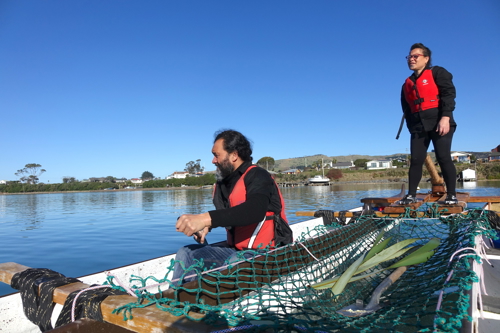
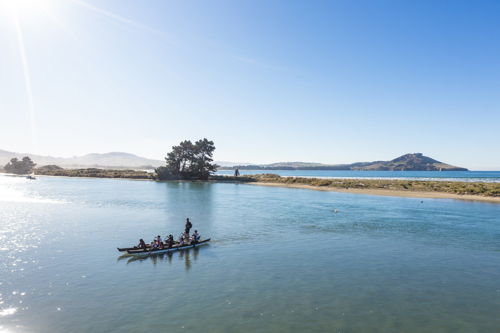
My first task is to help paddle a modern unua waka across the glassy surface of Waikouaiti River lagoon to Ōhinepouwera Spit.
“We want you to experience how our people traversed the oceans on waka to discover and call New Zealand home,” explains Tau, who is manning the rudder.
Once we reach Ōhinepouwera on the other side, Irie hands me a native plant. “The rūnaka has a 200-year restoration project here,” she explains. “We’re replacing exotic species with native plants, which we’ve grown at our own nursery.”
Today we’re planting the native sand-binding pīkao. As Tau explains, in Māori mythology pīkao represents the forest god Tane Mahuta’s eyelashes, which he threw along the coast of Aotearoa as a dividing line between himself and his brother Takaroa, god of the ocean.
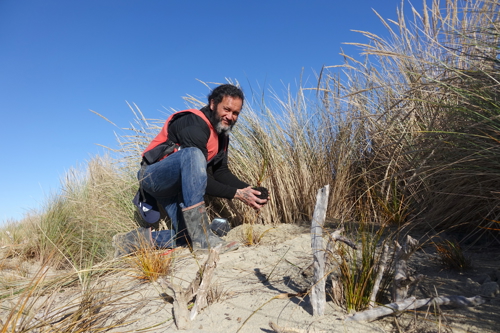
In total, visitors have helped plant about 1000 native plants on the spit.
Amy is proud of what the waka tour achieves. “We want to educate people at our place, about our past – but also how we do things now.”
By encouraging visitors to learn at a place and involving them in activities like walking, paddling a waka and planting a tree, she hopes they gain a deep understanding of the rūnaka’s values in a modern context.
As well as welcoming independent travellers and organised tours through cruise ships that dock in nearby Port Chalmers, the rūnaka also offers their tours to school groups. In the past eight months over 300 school students have travelled to Karitāne to make Huriawa the focus of their Aotearoa New Zealand Histories curriculum studies.
“I don’t know anywhere else where this kind of cultural experience is offered to visitors,” says Jill. “Not only do Karitāne Māori Tours offer a unique heritage experience, but they give us all a chance to give something back.”